
and the rising need for generalists
What Is a Career Pyramid?
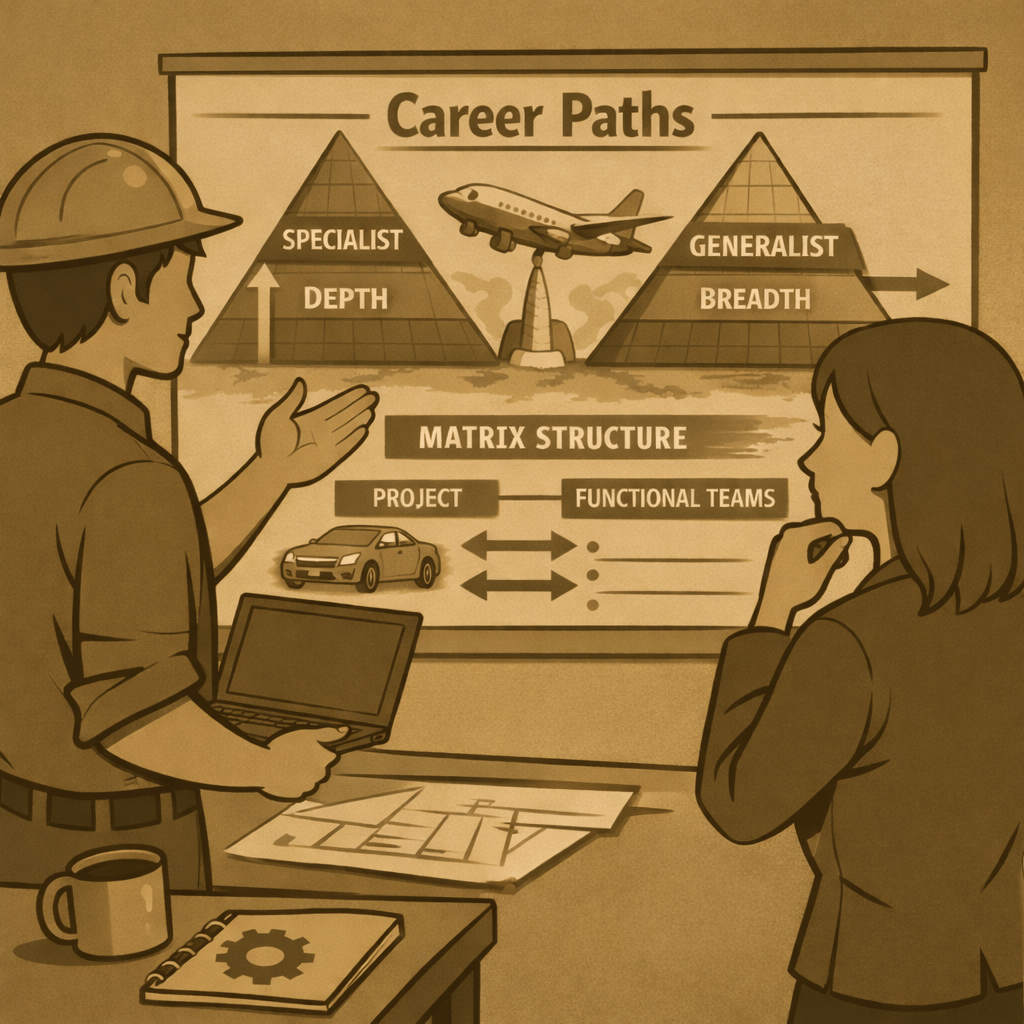
A career pyramid is like a career ladder, except it is wide. Instead of only moving up, you can move up or across. Moving up the pyramid signifies depth in a specific field—say, power electronics—while moving across signifies breadth, such as hardware product development, which spans many different pyramids of expertise.
Over the course of my career, I have had the chance to be part of both large, traditional hardware development organizations and startups. Large, traditional organizations often operate like overlapping pyramids. Each pyramid of expertise has an assigned technical fellow who has dedicated their life to that subject, while more generalist engineers operate across many pyramids, executing hardware development or sustainment.
Early in your career, you are expected to choose which expertise—such as power electronics—you want to belong to and then grow through the ranks of that specialization. The interesting (and difficult) part is that once you choose a specialization, there is often a point of no return. You become stereotyped by the work you have done up to that point, unless an urgent need arises or times are rough and there is no work available in your specialty. The only real escape is usually to switch careers entirely or pursue a master’s degree in a different specialization. The drawback is that by then you are already several years into your career, and it is still very hard to transition into a new field. From a hiring manager’s perspective, it is easy to find other, more competitive candidates who already have direct experience.
History and Example
Where does this multi-overlapping pyramid structure come from, and why might it be less useful in the modern age? No one knows for sure when it became popular, but a common claim is that matrix management emerged in the United States around the 1950s. This was the era of the World War II aerospace boom, followed shortly by the Cold War and the Space Race. Boeing was one of the first major corporations to adopt this model, and NASA soon followed.
Matrix management—or a multi-matrix organization—is defined by having two reporting structures. One organization is aligned to the project or program, and the other is aligned to a function. For example, imagine a program developing an automobile that needs thermal analysis for the car’s HVAC system. The program requests support from the thermal analysis functional group, which assigns an engineer to perform the task. If the analysis shows that the HVAC unit is undersized relative to requirements, the program must decide whether to waive the requirement or redesign the HVAC system to comply.
The Need for Generalists
If you run your own company with no employees, you are automatically a generalist. Of course, that model is not sustainable at scale. However, hardware engineering companies—strongly influenced by the success of software companies and startups—have begun to pivot away from large matrix organizations toward flatter, more nimble product organizations focused on execution.
In this style of organization, breadth and cross-domain capability are often rewarded more than deep expertise in a single domain. In fact, many of these companies avoid developing or retaining narrow expertise unless it is absolutely necessary. One reason is that field experts are often inflexible in their career trajectories. For example, an expert in power electronics is unlikely to take a role focused on product execution, such as transition to production.
This is why the subtitle of this article is The Need for Generalists. It is not meant to deter you from pursuing your specific interests, but to encourage you to learn a little bit about everything. Doing so makes you extremely valuable when it comes to execution.
 EngineersTeaTime
Leave a comment