

I remember taking linear algebra and differential equations and thinking, when and for what will I ever need to know all of this?
Many engineers I had chatted with up to that point had told me they didn’t really use advanced math, physics, or complex engineering concepts in their actual jobs. Most of them mainly used Microsoft Office, some sort of CAD software, or a programming language.
To a student staying up until 2am for days studying for a linear algebra exam, a circuits exam, and an electromagnetism exam all back to back… this was honestly pretty discouraging.
Then one day I walked into my aerospace dynamics class and met the sweetest, smartest female engineer who happened to be my professor.
She shared stories about her work at NASA solving some of the most interesting engineering problems imaginable.
And for the first time… engineering felt alive to me.
Then right after that class, I walked into my very first controls class and it all just clicked.
Everything I had been learning up to that point — all the math, physics, pain, and tears — finally came together for me in dynamics and controls.
So some engineers actually do use a lot of it. Every day.
Take a system, derive its equations of motion, understand how it naturally behaves, then use control theory to make that system behave the way you want… or at least try.
How freakin cool is that?
Controls engineers build the brains.
When I got that job offer from the dynamics and controls team a year before graduating, I was beyond stoked and grateful. Not only did I have a job lined up before graduation, but I was joining the exact team I thought did the coolest work.
Then young, excited Mel showed up to work and quickly realized there was a mountain… actually more like an entire valley… of skills and processes she was going to have to learn on the job.
I was so unprepared.
For starters, the level of MATLAB, coding, modeling, and software development I needed was substantially beyond anything I had done in college.
I took extra online courses and YouTubed my way through as much as possible after work just trying to bridge that gap.
Dynamics? Well… taking astrodynamics and flight mechanics in college was incredibly helpful, but nobody prepares you to take a spacecraft and break it down into flexible and rigid bodies.
For that, I took the internal dynamics courses the company offered to our team.
Then of course came systems engineering.
What is a good requirement versus a bad one?
How do you implement that requirement into your model?
How do you verify it?
How do you unit test it and eventually integrate it into a full system?
Then came SIL testing. HIL testing. Integrated subsystem testing.
Then physical testing.
Working with the test team to make sure the commands my autonomous system was sending were correct, safe, and happening at the right time.
And then… launch support.
Going into the mission control room. Supporting launch. Supporting in-orbit tuning.
When I look back now, I honestly don’t even know how I made it through all of that. From day one, it felt like drinking from a firehose.
But also… how cool is that?
Every program I worked on, including NASA Psyche and PPE, taught me something new.
I made so many mistakes. But I also came up with so many solutions. Some honestly surprised me with my own ability to troubleshoot on the spot.
And I think that’s what engineering is really about.
Engineering is learning how to sit with ambiguity.
Taking an abstract idea or a complex problem, sitting with that uncertainty, discomfort long enough to eventually make sense of it all.
Then one day you look around and realize there was an entire team beside you helping make the impossible feel possible.
Over the years, I started realizing that controls engineering is really a combination of dynamics, physics, software, systems engineering, testing, and modeling.
So I put together the diagram below as a reflection of the skills I’ve had to build throughout my career and what I’ve seen used in industry.
My hope is that this inspires you, helps guide your learning, and gives you a little more insight into what dynamics and controls engineering can actually look like in the real world.
So what skills actually make you a controls engineer in industry?
Like all engineers… I made a flow diagram.
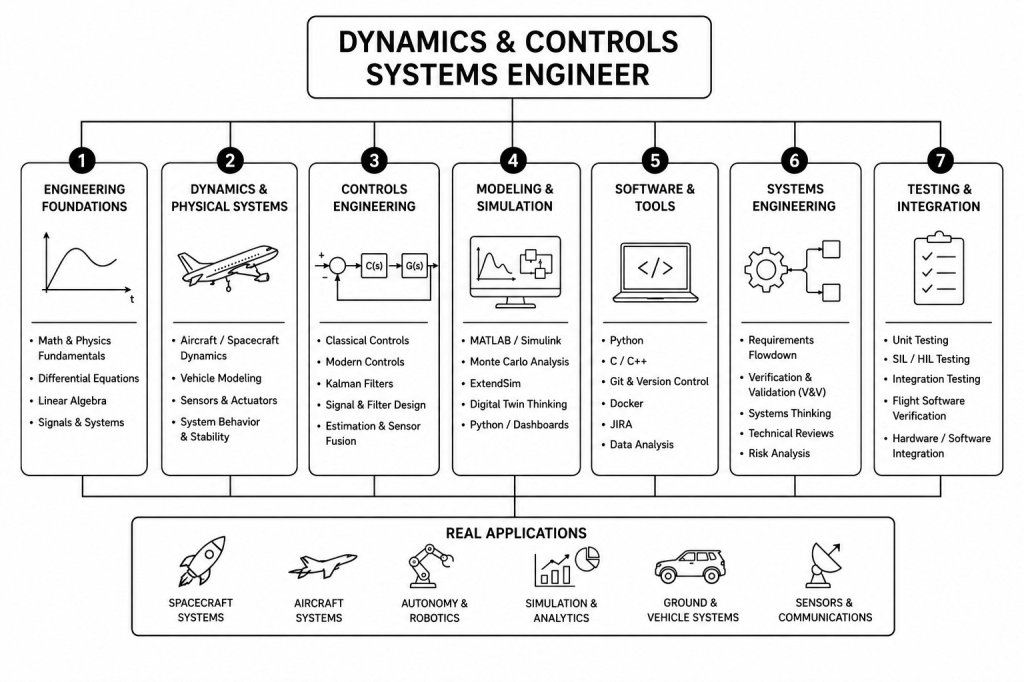
For the full detailed version of this diagram, CLICK HERE.
Resources:
Project Ideas:
with love,
mel
 EngineersTeaTime
Leave a comment